Showing posts with label economics. Show all posts

Monday, 1 April 2013

Our Choice: Rocket to a Warming Catastrophe or Turn Down the Jets?


The Future is Certain, Unless...

We live in an astonishing times.  We can predict the future.  In one ever-increasingly certain area of knowledge – the overall global trend of climate and its relation to carbon emissions – we now know what is happening and where we are headed.  More emissions will lead to more global warming, a warming to temperatures beyond anything humans have experienced in our species' entire existence.

What is more, the most up-to-the-minute science, reconstructing the Earth's average surface temperature over the past 20,000 years, shows how massively humanity's recent intensive use of fossil fuels has disturbed the world's climate.

If we do act fast to lower global emissions radically, by beginning massive and immediate actions now, by altering personal behaviour, and rapidly decarbonising energy, goods and services, we really can have a limiting effect on future temperatures.  If humanity does not act and emissions continue unabated, the climate will pass through temperature level "trapdoors" that will be irreversible for a thousand years or more.

The Past as Guide to the Future

Marcott et al, authors of the most recent past temperature reconstruction, in summarising their results, state:
[T]he decade 2000-2009 has probably not exceeded the warmest temperatures of the early Holocene, but is warmer than ~75% of all temperatures during the Holocene. In contrast, the decade 1900-1909 was cooler than~95% of the Holocene. Therefore, we conclude that global temperature has risen from near the coldest to the warmest levels of the Holocene in the past century.

Jos Hagelaars, here, has combined temperature reconstructions for the past 22,000 years, including the recent one from Marcott et al., with temperature records for the past 120 years, and with the emission path that humanity is now following – which is tracking the very worst emissions scenario envisaged by the Intergovernmental Panel on Climate Change.  

Holgaars' presentation is as below and makes the recent century's change compared to the past very clear indeed.  The extraordinary rate of change now being seen is unprecedented in tens of thousands of years of human history and pre-history.
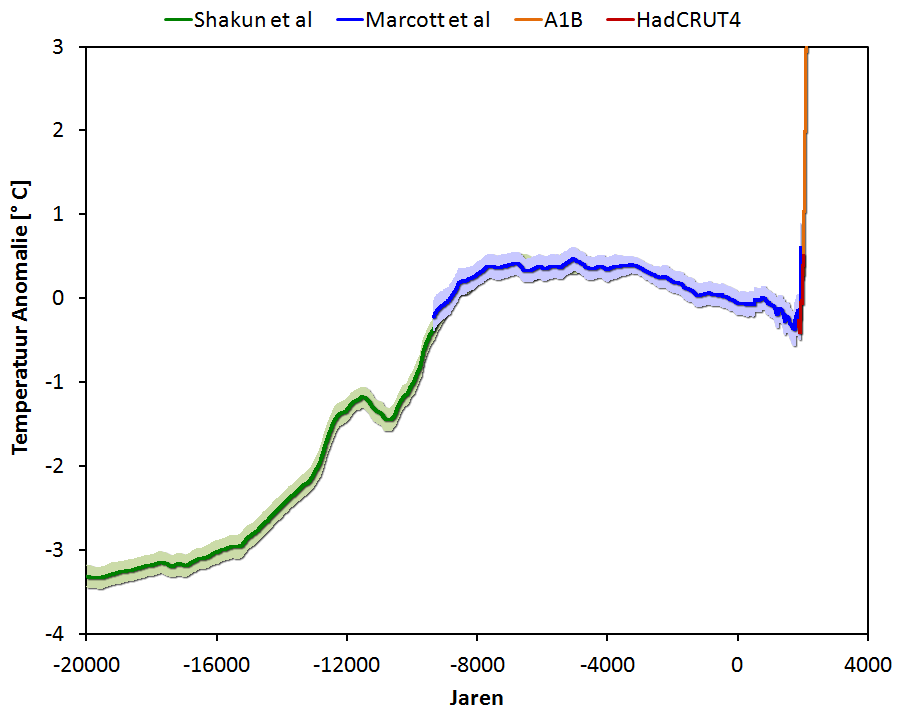

Jos Holgaars' presentation of temperature reconstructions, recent temperature, and IPCC forecast.

After a long slow cooling in temperature from about five thousand years ago, the recent increased use of fossil fuels, especially from 1900 onward, has launched global temperature upward at an unprecedented rate (as shown at the most recent part of the blue line), a rate that will continue (as shown in red) if emissions continue.  This warming will not be continuous and warming will not occur evenly around the world, but it will happen.  It has already begun to show the first damaging effects in the increasing weather extremes and weather event intensities.

To give a sense of where humanity's rocket launch into higher temperatures is taking us we can look to the past.  In the Permian extinction of 251 million years ago, 95% of all species on Earth were eliminated due to a global warming of 6ºC, in that case naturally caused, probably by volcanic eruptions.  Corresponding to the currently forecast 'business-as-usual' emissions, our current path, the resultant amount of warming by the end of this century is very likely to be around 6ºC in only ninety years from now.  This warming is a result of human interference in Earth's biosphere, the sudden addition of massive amounts of carbon dioxide and methane from burning of fossil fuels with additions from agriculture and clearing forests.  

If ever there was a time for precautionary action it is now,  while it is still possible to act.  Science also shows that urgent reductions in emissions could limit warming to a far safer, though still dangerous, level of 2º to 3ºC.  "Dangerous" is far preferable to catastrophic.

Only the choices we, as an intelligent species, make right now in the light of this information, will determine the level at which warming stops.  Humanity, collectively, will have to act fast but it is still possible to limit the warming, if and only if we can reduce emissions very rapidly.  Mitigating (reducing) emissions is a far safer and more certain course than geoengineering which has very unpredictable and very uncertain, often short-lived outcomes.

Below, I have added temperature bands to Holgaars' temperature anomaly versus time graph, to emphasise how different the future is likely to be compared to the past.  I have added date markers for agriculture to show how all of recent human history has occurred within a very narrow temperature (with a constant CO2 level close to 280 ppm).  By the end of this century the CO2 level is likely to be three times as great pushing temperatures ever upward.

The Choice: Delay Action or Act Now

We are heading up to higher temperatures than mankind has ever experienced as a species or as a global civilisation.  We now know this with certainty.  In sum, the remaining uncertainties are not reassuring and many of them such as methane from melting permafrost are likely to add to the warming once they begin in earnest as global temperatures reach tipping points.  Therefore, the humans who live now, we ourselves, can choose to add greenhouse gases to the atmosphere, at current, large and also increasing future rates, thereby knowingly choosing an apocalyptic future of climate extremes outside anything we have known before.  Or we can choose to act.

Either way, humanity and we individually are making a decision right now by our actions: to do nothing or to do something.  To date, despite much talk, nothing has been achieved.  Global emissions have doubled since 1990 and they continue to increase because nation states have not peaked emissions, quite the reverse.  They have been dishonest brokers in addressing the problem (see previous post).  

Starting this year every nation has to start by being honest about the warning our science is giving us.  At this point we have to peak emissions urgently, even if it costs economic growth.  Whatever fossil fuelled, economic growth could be achieved over the next few decades will be undermined by economic decay and possible collapse due to climate damage caused by fossil fuelled, economic growth that could be achieved over the next few decades.  We are loading the dice and nature will keep on rolling them.

Apologies for the necessary shouting on the next line:
WE HAVE TO ACT NOW!
It is our emissions now that are adding to warming.  By lowering emissions now – rapidly, globally, politically, corporately, nationally, regionally, locally, personally – we can still change the future to limit warming. Anyone unaware of this needs to become aware of it.  Anyone aware of the warnings needs to act on them.

Currently, rich nations, businesses and individuals are acting as though their own future is not in doubt and that 'business as usual' is possible into the far future.  The rich need to finally realise that we really are all in this together.  The futures of their nations, their businesses, their shareholdings, and their children are also in doubt if they do not choose to act for a safer long-term outcome by lowering emissions urgently and radically.

We really do have a choice.  We can still make the right one.


Wednesday, 27 March 2013

One Simple Fact: Ireland's Climate Bill and Policy Denies the Fundamental Climate Threat to Ireland's Future Security

Emissions Equal Warming

The basis of global climate reality is that the science of climate change has revealed one simple fact, a fact that continues to be ignored by Irish and most international policy: 

The cumulative total of humanity's greenhouse emissions – those already released, those we emit right now, and those emitted in the very near future – will determine the very survival of global human civilisation and of much of the Earth's ecosystem.  

The final extent of global warming and the resultant climate change damage will depend on the total future carbon emissions 'budget' emitted globally, a budget that has to be divided on some equitable basis, between all the countries of the world and with twenty or more future generations of the entire world population, including our own children.  

We in Ireland have to take responsibility for our part in staying within our carbon budget by not displaying in our policies, as now, a complete ignorance of this fundamental finding of climate science.  This is the critical basis of any climate policy.  Even NGOs and opposition proposals display their lack of basic understanding by concentrating on misleading and effectively meaningless 'date-rate' targets such as '90% decrease in emissions by 2050.  Only the total accumulated carbon budget stock of emissions is important, the rate at any particular time is not unless the date-rates are explicitly linked to a carbon budget and corresponding emissions path.

Currently, for a (still very dangerous) 'safe' warming of 2ºC in average global surface temperature, we will easily exhaust our 500 year global budget within the next fifteen years.  An average warming of 4º to 6ºC with catastrophic effects, within the lifetime of children being born now, is entirely plausible.  Only by adopting a 'safe' emissions path within the carbon budget is it likely that the world can avoid economic, environmental and societal collapse.  If not avoided, the global as well as the local results will deeply affect Ireland and its people – how could they not?  

A far safer course is still possible but time is running out very fast.  And even if we cannot now avoid more than 2ºC of warming it then becomes even more important to avoid 3ºC by acting even more strongly now to peak emissions.

Ireland Must Face the Future Honestly


Every country must therefore follow an emissions path to safety and Ireland can be no exception.  To argue that Ireland is 'too small to make a difference' or that 'other countries are more responsible' is simply immoral, these are justifications for insular and short-term greed to allow us to take more of the available carbon budget for ourselves now at the expense of others elsewhere or in the future.

Ireland's government and administration continue to be in a state of denial regarding the 'one simple fact'.  The Heads of Bill for our proposed climate legislation and the National Economic and Social Council (NESC) Secretariat's recent Report both entirely ignore the requirement for a global carbon budget, and the consequent moral necessity of following the safest possible emissions path, one that sums to Ireland's share of that global carbon budget.  

Economists repeatedly practice the same denial, even though you might imagine they would be able to grasp the simple concept of a budget.  What happens as world economic growth becomes impossible over the next decades due to food shortages, population migration and extreme weather events due to climate change?  What price human civilisation?  

Most economists do not seem to understand that 'time discounting' does not apply to a sustainable global civilisation.  The price worth paying to preserve it has to be worth paying and it is the wealthiest countries, corporations and individuals that are going to have to pay most of it as they bear the most 'emissions responsibility'.  This of course is the real problem: they don't want to.

Economists and our own Department of Finance need to wake up and smell the coffee.  If they do not help us to develop an economy that can work within our carbon budget they are ignoring the 'one simple fact' and imperilling our futures.

Instead of seeing the global external risks from climate change, which threaten our food, property and security, our leaders and 'experts', and often we ourselves, try to concentrate on the short-term Irish and the local to Ireland (relatively benign) effects of global warming.  This is promoting collective denial of the growing extreme danger that lies ahead and is becoming evident now.  It is our own high emissions now that are further compromising the futures of our children and, especially, the near future of those countries most vulnerable to climate change damage.  

Unless our politicians and advisors, and most of all ourselves, finally come to terms with the 'one simple fact' of global warming and its implications, we will continue on a highway of intensifying risk.  We would all prefer to delay difficult actions into the future but sadly the best advice available and the, already apparent, damage effects of global warming show that we cannot.  Every year of high emissions that goes by increases the amount of regulatory or other action that will be needed – ironically the very opposite outcome wished for by those who are acting to delay action.  They are increasing the potential for greater difficulties.

We have now have no option but to act urgently by massive and rapid decarbonisation of our energy supply and by cuts in our own consumption and in types of agriculture that cause emissions.  To do this equitably so that the poorest do not suffer is the real challenge for governments and economists.  They and we will have to decide whether ideologies and rhetoric are effective in addressing climate reality.  So far they are ignoring reality – at great cost to our future.

Heeding the Science Gives Us Hope


The science says we have to peak emissions by 2015 and decarbonise very rapidly thereafter.  Every year of delay in peaking and acting greatly compounds the danger.  Our proposed policy is to grow emissions.  This is Ireland's vote for humanity's self-generated collapse.  

It is now our collective responsibility to choose the safest carbon emissions path.  To be informed we as citizens need to know we are choosing between: the safest, most conservative course; and the our present dangerous course that risks immense damage to Ireland's security and our children's future.  It is our choice.  And now is when we must act.

Those who are not alarmed by the 'One Simple Fact' are not paying attention.  If you are alarmed, or even just concerned, let your Dáil TDs know it.  Our voices really can make a difference especially if we phone our TD or state our concerns in person to them.  Ultimately, it is politicians who have to make these difficult choices and they need your strong support to make them. 

This would be a good time to encourage TDs to ensure that our legislation at least acknowledges the need for a carbon budget approach.  If we cannot even begin to be honest about even the most basic fact of global warming – our own responsibility in choosing or at least acknowledging our future carbon budget – we have a big problem.  Right now the real threat to our long term future security lies in choosing to follow the stated policy that ignores the most basic fact shown by climate science.  Ignorance may be bliss but it cannot be a excuse.

Without such urgently needed honesty, regarding the scale and immediacy of the challenge we face, the proposed legislation is literally hopeless.  It would make a change to see some signs of hope in a more honest acceptance of our choices.